

This article is about the molecule and the research. On the names and their spelling, the Consultório de Psiquiatria has its own article on ketamine, cetamina and esketamine (opens in a new tab).
Two forms of one molecule: S and R
Ketamine combines two molecules that are mirror images of each other, like a left and a right hand [1].
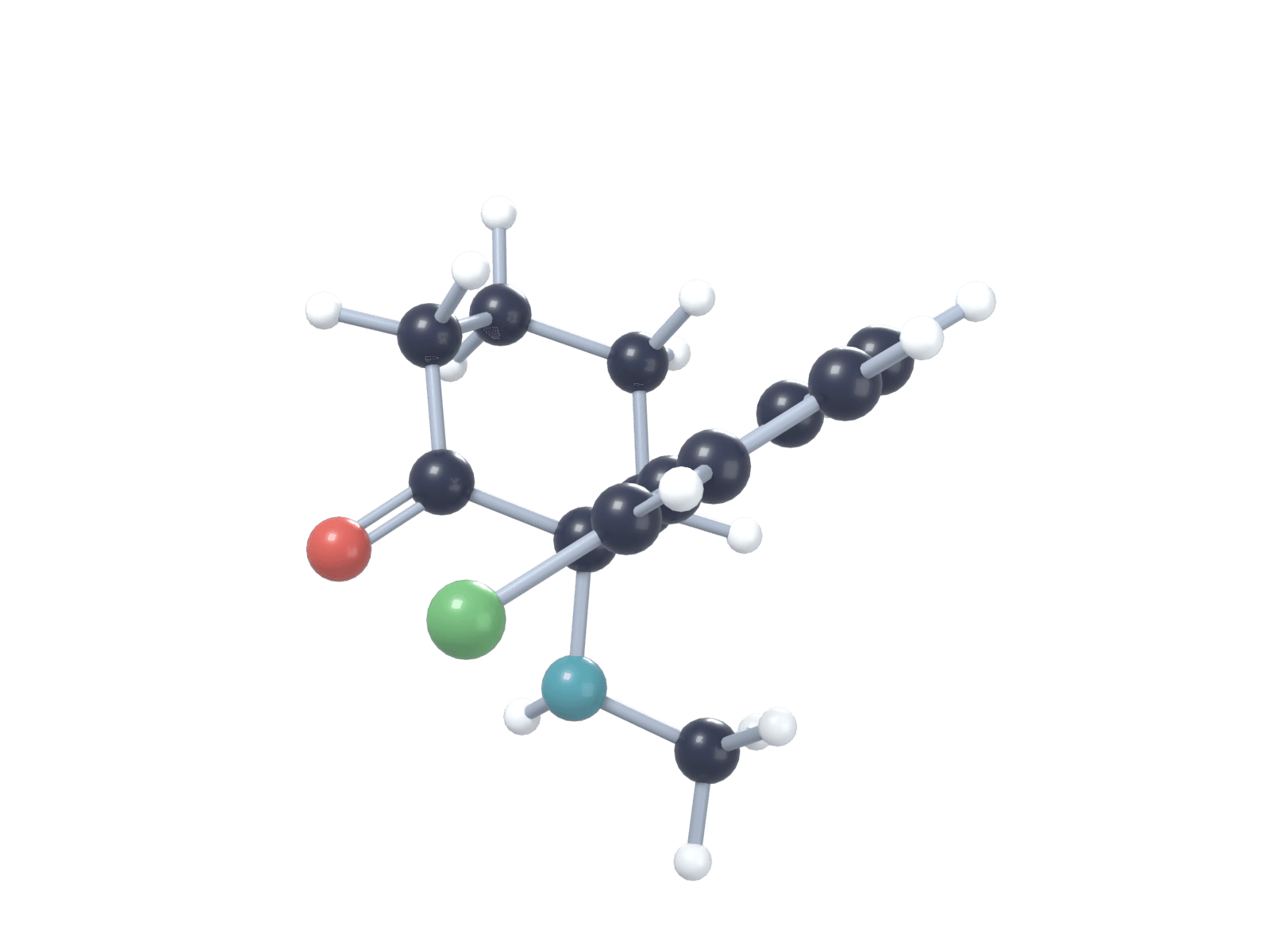
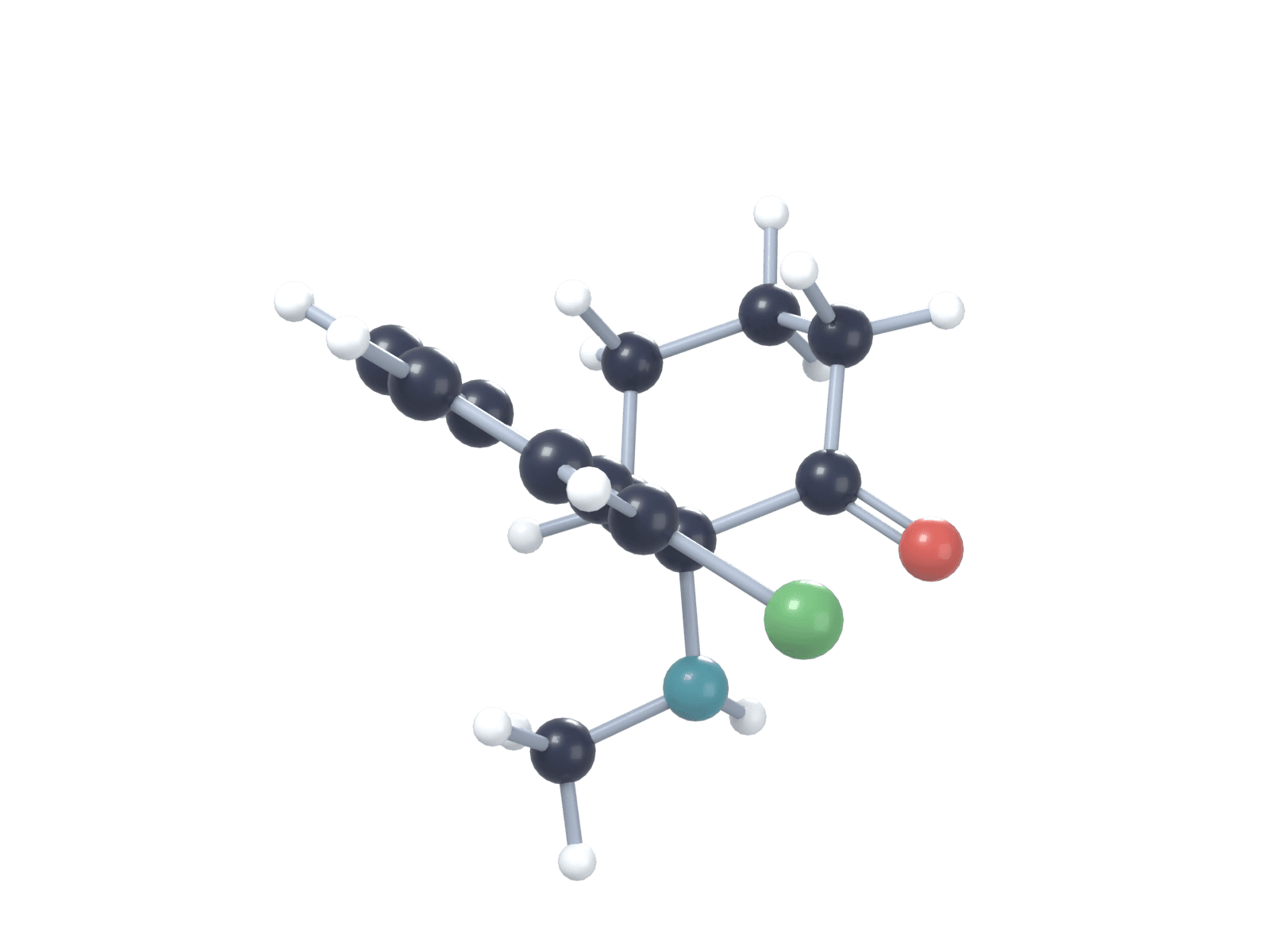
- Same formula: C₁₃H₁₆ClNO, in both forms [2] [3].
- Racemic mixture: by chemical definition, the two forms in equal parts [4]; the chemical name marks it with “(±)” [2].
- Esketamine: the S form alone [3].
- Arketamine: the R form alone [5].
Learn more why the shape matters
The S form is esketamine and the R form is arketamine: the same set of atoms arranged in two ways [1]. Ketamine and esketamine have the same chemical formula; the anaesthetic is the mixture of both forms.
Ketamine binds inside the channel of the NMDA receptor, at a site known as the phencyclidine site, and blocks it non-competitively [6]. Because this is a fit inside the channel rather than contact at the surface, it makes sense that the three-dimensional shape affects affinity.
In a 1985 study of five volunteers, the pharmacokinetic profile of each separate form did not differ significantly from that of the mixture [7]: the difference between the forms lies in the fit, not in how long each stays in the body.
What is known about the mechanism of each form
All three block the NMDA receptor; the rest of the mechanism is a hypothesis, mostly from animal work.
- S form: three to five times the affinity of the R form, depending on the study [8] [6].
- Mechanism unknown: as the US esketamine label states [3].
- Metabolites: one had an antidepressant-like effect in mice without blocking the NMDA receptor [9]; the hypothesis was challenged [10].
- Opioids: naltrexone weakened the effect in a small trial [11], but not in another, from 2025 [12].
Learn more numbers and debate
The NMDA receptor is a glutamate receptor, and the three forms block it with different affinities. Anything beyond blocking it is a hypothesis under study, and the affinities were measured mostly in animal tissue [6].
In the 1997 study, in rat cortex, the S form had an affinity constant of 0.30 µM and the R form 1.40 µM; the authors described the difference as five-fold [8]. The 2018 review, which brings several studies together, summarises it as about four-fold, with the S form having twice the affinity of the mixture; in human brain tissue, confirmation comes from only two brains [6].
In acute pain after oral surgery, the S form was four times as potent as the R form, and the mental effects were qualitatively similar for all three forms [13].
The US label for esketamine states that the mechanism of its antidepressant effect is unknown [3].
The metabolite in question is (2R,6R)-hydroxynorketamine, which had antidepressant-like effects in mice without blocking the NMDA receptor [9]. After the objection published in 2017 [10], a 2019 study in rodents replied that, at the concentrations that matter, it does not block the NMDA receptor [14]. In people, there is only one phase 1 safety study, in healthy volunteers, with no measure of antidepressant effect [15].
Animal research is divided: in mice, the R form had a stronger and longer-lasting effect than the S form [16]; in rats, the S form and the mixture increased the AMPA receptor response, and the R form did not [17].
In the first trial, naltrexone weakened ketamine’s antidepressant effect; it was stopped at an interim analysis, with 12 people completing both conditions [11]. The 2025 three-arm trial included 65 adults with depression and alcohol use disorder, and the two groups that received ketamine had comparable results: naltrexone did not change the effect [12]. The populations differ, and the question remains open.
What studies in people show
No trial has compared all three forms in depression; esketamine and racemic ketamine have been compared head to head once.
- Head-to-head trial: 63 adults with treatment-resistant depression; esketamine was not inferior at 24 hours [18].
- Remission: 29.4% with esketamine and 24.1% with racemic ketamine [18].
- Side effects: mild and similar [18].
- Meta-analysis: across 36 studies, ketamine was linked to more response and remission than placebo [19].
Learn more how to read the comparison
In the head-to-head trial, esketamine was not inferior to racemic ketamine; remission was measured at 24 hours, and side effects were mild and similar in both groups. The esketamine dose was half the racemic ketamine dose, and the mean MADRS score fell from 33 to 16.2 with racemic ketamine and to 17.5 with esketamine [18].
Of the 36 studies in the meta-analysis, nine used esketamine and the rest racemic ketamine; the result is the pooled one [19]. An indirect comparison, across different trials, is no substitute for a trial that compares the forms directly.
Arketamine: research only
Antidepressant-like effects in mice; in people, only small studies, with no difference from placebo where there was one.
- Open-label study (2021): 7 people, no control group; MADRS from 30.7 to 10.4 within a day [20].
- Randomised pilot (2023): 10 people; not superior to placebo [21].
- Industry phase 2a: 102 participants; no difference from placebo at 24 hours, no peer-reviewed publication [22] [23].
- Programme stalled: a 5% probability of success, according to the company [24].
Learn more numbers and safety
The open-label study included people with treatment-resistant depression; the MADRS figure is the mean score [20]. The authors of the 2023 pilot describe it as small; the analysis was limited to the first week: symptoms improved over time, but with no difference between arketamine and placebo [21].
In the phase 2a trial, the 24-hour difference was the primary endpoint, according to the registry and the company: the MADRS score fell by 13.7 and 15.3 points in the two arketamine groups and by 13.7 with placebo [22]; the company’s own target was a difference of 5 points or more [23].
Dissociation was nearly absent in the open-label study [20], and in a study of healthy volunteers the R form did not produce psychotic symptoms, unlike the S form [25]. Safety cannot yet be properly judged: the samples are small, and in a follow-up of three participants from the phase 2a trial one person developed a substance use disorder [26].
Regulatory status: what is authorised
Only esketamine is authorised for depression; racemic ketamine is authorised as an anaesthetic; arketamine is not authorised.
| Esketamine S form | Racemic ketamine S and R forms | Arketamine R form | |
|---|---|---|---|
| What it is | The S form of the molecule only [3] | The mixture of both forms, marked “(±)” in the chemical name [2] | The R form of the molecule only [5] |
| NMDA receptor | The highest affinity: three to five times that of the R form, depending on the study [8] [6] | About half the affinity of the S form [6] | The lowest affinity of the three [6] |
| Research in depression | Trials that led to authorisation; in one head-to-head trial, not inferior to the racemic form at 24 hours [27] [18] | Placebo-controlled trials; in a meta-analysis of 36 studies, the most studied form [19] | Small studies only; in the two placebo-controlled trials, no different from placebo [21] [22] |
| Regulation | Authorised in the EU since 18 December 2019, for treatment-resistant depression, with an antidepressant [27] | Authorised as an anaesthetic; in depression, off-label use [28] [29] | Not authorised; research only [24] |
- Esketamine in the EU: a nasal spray, for treatment-resistant depression, with an antidepressant [30].
- Second indication: a psychiatric emergency in a moderate to severe episode, short term [30].
- In Portugal: funded for hospital use since May 2025, for a restricted group [31].
- Ketamine in depression: off-label, always with a psychiatric assessment [29]; see how the assessment works.
Learn more Portugal and the United States
In the EU, esketamine is authorised for adults, in combination with an antidepressant; in the second indication, with an oral antidepressant [30].
Funding in Portugal covers a narrower group than the authorisation: adults with treatment-resistant depression who have not responded to at least three different antidepressants, including combination or augmentation strategies, and who have already had psychotherapy, among other conditions [31]. Using a medicine outside its approved indications is the responsibility of the prescribing doctor [32].
In the United States, esketamine was approved in March 2019 [33], and since January 2025 also as monotherapy, an indication that does not exist in the EU [3]. In 2023, the FDA wrote that ketamine is not approved for any psychiatric disorder [1].
More on the molecule and its history on the ketamine and esketamine page.