

Sunlight through the green leaves of a tree

Ketamine and esketamine therapy: assessment in Lisbon, sessions in Sintra

At KETAMED, ketamine therapy is one of the approaches that may be considered for treatment-resistant depression, that is, depression that has not responded to adequate treatment. It always begins with a psychiatric assessment in Lisbon; sessions take place at Clínica da Beloura, in Sintra, under medical and nursing supervision.

Who it is for: treatment-resistant depression

Research on ketamine and esketamine focuses mainly on treatment-resistant depression, that is, depression that has not improved with at least two different antidepressants at an adequate dose and duration [1] [2].

Whether it is indicated is always decided in an individual psychiatric assessment, which considers each person’s medical history, previous treatments, physical health, usual medication and goals. The assessment may conclude that this treatment is not the most suitable, or that it is not indicated.

To learn more about the condition, see treatment-resistant depression: definition, assessment and options (opens in a new tab) at the Consultório de Psiquiatria.
Request an assessment consultation

How ketamine therapy works

From the assessment consultation to follow-up, each stage helps us decide the next steps safely.

Explore each step of the pathway.

  1. An initial medical consultation to understand your situation, answer your questions and agree the next steps with you.

  2. A psychiatric and physical health assessment, including blood pressure, usual medication and possible contraindications. Additional tests may be needed.

  3. Detailed information about the procedure, expected effects and possible difficult experiences, and informed consent.

  4. At Clínica da Beloura, under medical and nursing supervision, with vital signs monitored during the session.

  5. A recovery period at the clinic, with your clinical state monitored, until you are ready to go home accompanied.

  6. When applicable, psychological support sessions to understand the experience and turn it into concrete change in daily life.

  7. A review of the clinical response, side effects and whether the plan should be adjusted or ended.

Step 1 — Assessment consultation

An initial medical consultation to understand your situation, answer your questions and agree the next steps with you.

Step 2 — Clinical assessment

A psychiatric and physical health assessment, including blood pressure, usual medication and possible contraindications. Additional tests may be needed.

Step 3 — Preparation

Detailed information about the procedure, expected effects and possible difficult experiences, and informed consent.

Step 4 — Monitored session

At Clínica da Beloura, under medical and nursing supervision, with vital signs monitored during the session.

Step 5 — Recovery

A recovery period at the clinic, with your clinical state monitored, until you are ready to go home accompanied.

Step 6 — Integration

When applicable, psychological support sessions to understand the experience and turn it into concrete change in daily life.

Step 7 — Follow-up

A review of the clinical response, side effects and whether the plan should be adjusted or ended.

Ketamine, cetamina, esketamine: what the names mean and how they differ

Ketamine is called “cetamina” in Portuguese, and the spelling “ketamina” is also common; they are the same substance. The same applies to esketamine (“escetamina”, “esketamina”) [1] [3].

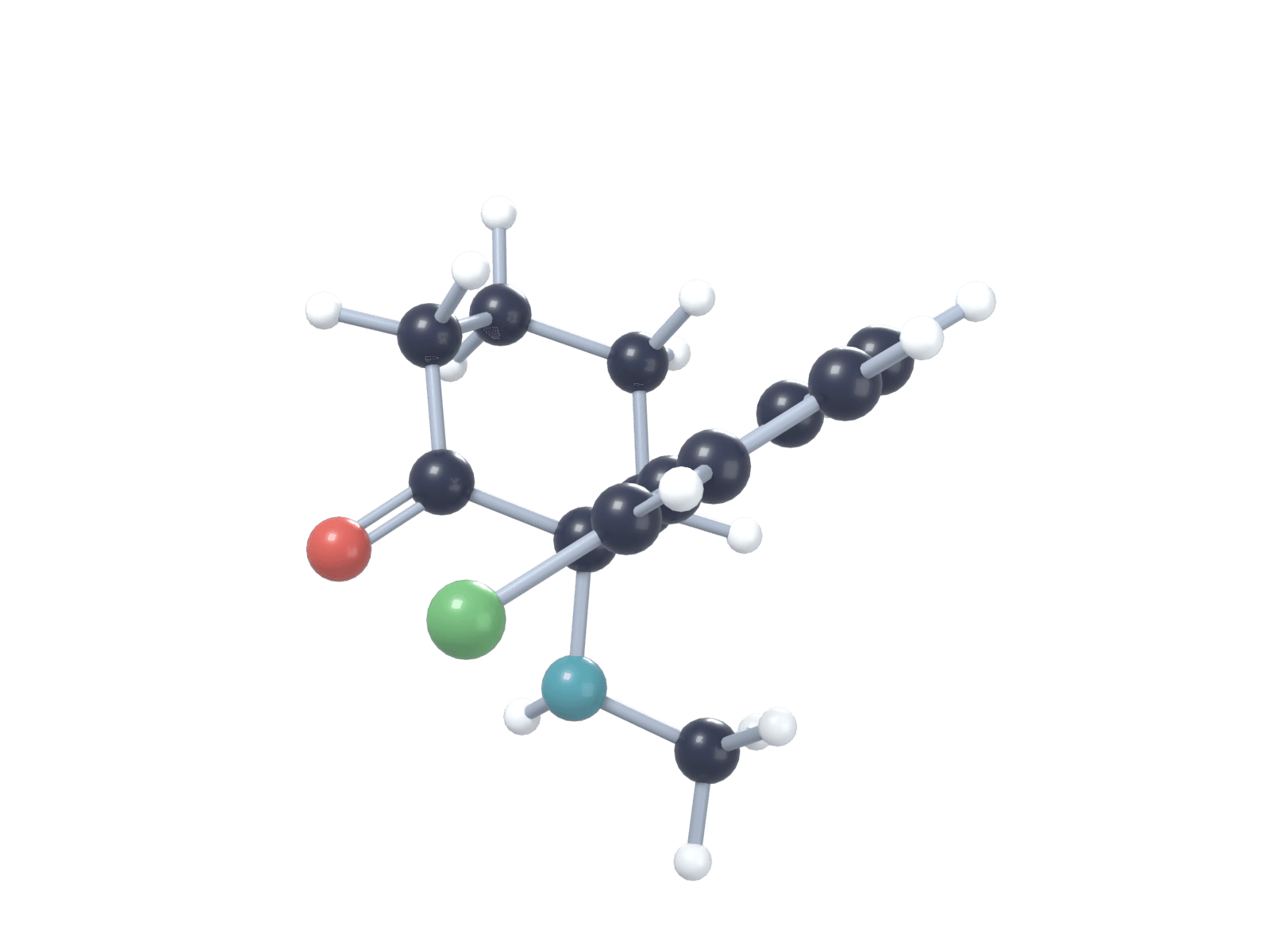
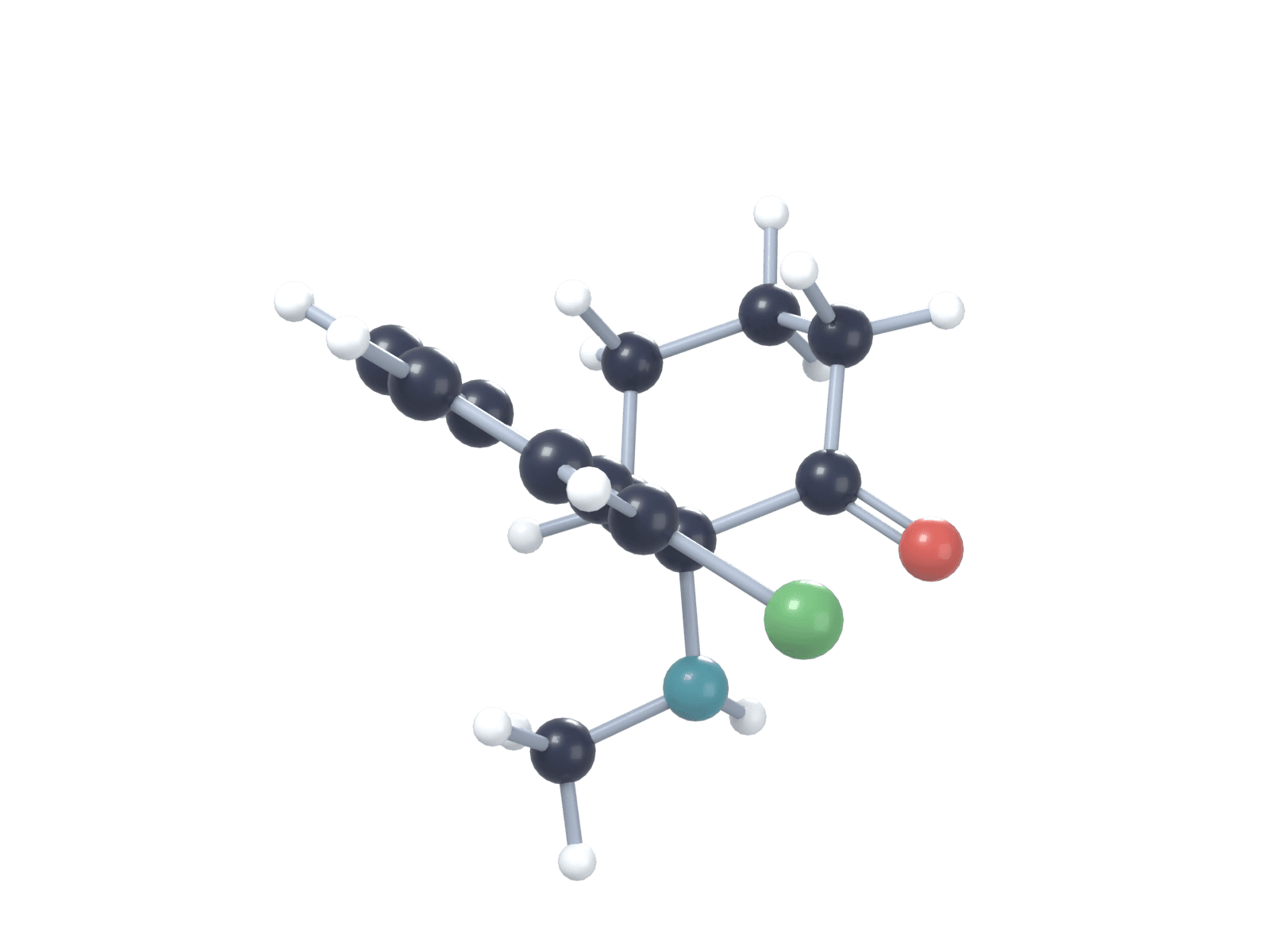
The ketamine molecule exists in two forms that are mirror images of each other, the S and R forms. The ketamine used in medicine is an equal mixture of both; esketamine is the S form on its own [6]. “Ketamine-assisted therapy” is used when sessions come with structured psychotherapeutic support [7].

S form of the ketamine molecule (esketamine) R form of the ketamine molecule
3D model of ketamine: the S and R forms, mirror images of each other. Drag or use the arrow keys to rotate.

Safety and contraindications

The most frequent effects reported with esketamine are dizziness, dissociation, nausea, headache, sleepiness and raised blood pressure [1]; ketamine trials mainly describe dissociation and a transient rise in blood pressure [2].

Monitoring
Blood pressure is measured before and after administration, and the person stays under observation until clinically stable. They should not drive or operate machinery until the next day, after a night’s sleep [1].
Contraindications
Conditions in which a rise in blood pressure or intracranial pressure poses a serious risk, such as aneurysmal vascular disease, previous intracerebral haemorrhage or a recent cardiovascular event; and hypersensitivity to ketamine or esketamine [1].
Careful assessment
A history of psychosis, mania or bipolar disorder, uncontrolled hyperthyroidism and raised intracranial pressure; it is not recommended in pregnancy [1].
Misuse
There is a risk of misuse and dependence, particularly in people with a history of substance use; administration is therefore always given and supervised at the clinic [1].

This is why a prior medical assessment, monitoring and recovery are part of the treatment.

What research shows in treatment-resistant depression

Trials describe an antidepressant effect that can appear within hours but is usually short-lived after each administration, and not everyone responds [8] [2] [9]. That is why the response is reviewed at follow-up and the plan is adjusted or ended.

A review of the evidence on ketamine in treatment-resistant depression (opens in a new tab), including esketamine and safety, is available at the Consultório de Psiquiatria.

Ketamine and esketamine: what they are and how they work

Frequently asked questions

Are ketamine therapy and ketamine-assisted therapy the same?

Ketamine-assisted therapy is ketamine therapy in which the sessions come with structured psychotherapeutic support. In Portuguese, ketamine is called “cetamina” (also spelt “ketamina”); they are the same substance.

What is the difference between ketamine and esketamine?

Ketamine is a mixture of two forms of the same molecule that are mirror images of each other; esketamine is only one of them, the S form. Esketamine nasal spray is authorised in the European Union for treatment-resistant depression; ketamine is authorised as an anaesthetic and its use in depression is off-label.

Who can have ketamine therapy?

It may be considered for adults with treatment-resistant depression, that is, depression that has not responded to adequate treatment. Whether it is indicated is always decided after an individual psychiatric assessment, which also assesses physical health and contraindications.

Is ketamine approved for depression in Portugal?

No. In Portugal, ketamine is approved as an anaesthetic; its use in depression is off-label, that is, outside the approved indications. It is an individual clinical decision, explained to the person and made with their informed consent. Esketamine nasal spray is authorised in the European Union for treatment-resistant depression.

Where do consultations and sessions take place?

The assessment consultation takes place in Lisbon, at Rua Latino Coelho 87 R/C. Sessions take place at Clínica da Beloura, in Sintra, under medical and nursing supervision.

Can I drive after a session?

Not on the same day. After recovery at the clinic, you should go home accompanied and only drive again the next day, after a night’s sleep.

Is the effect guaranteed?

No. In research, the antidepressant effect can appear within hours but is usually short-lived after each administration, and not everyone responds. That is why the response is reviewed at follow-up and the plan is adjusted or ended.

This page provides information about a clinical service and does not constitute advertising of medicines or a treatment recommendation. Any treatment is always an individual medical decision.

References

  1. European Medicines Agency. European public assessment report (EPAR) and product information for esketamine nasal spray; marketing authorisation in the EU since 18 December 2019. ema.europa.eu (opens in a new tab) Regulatory source
  2. McIntyre RS, Rosenblat JD, Nemeroff CB, et al. Synthesizing the evidence for ketamine and esketamine in treatment-resistant depression: an international expert opinion on the available evidence and implementation. Am J Psychiatry. 2021;178(5):383–399. doi:10.1176/appi.ajp.2020.20081251 (opens in a new tab) Review
  3. Ordem dos Médicos, Colégio da Especialidade de Psiquiatria. Resolução sobre o uso de Psicadélicos (CEP-2023-R-02), 3 de Agosto de 2023. (Portuguese Medical Association, College of Psychiatry: resolution on the use of psychedelics, 3 August 2023.) ordemdosmedicos.pt (PDF) (opens in a new tab) Guidance
  4. INFARMED (Autoridade Nacional do Medicamento e Produtos de Saúde), Comissão Nacional de Farmácia e Terapêutica. Utilização de medicamentos em regime off-label (orientação aprovada em Março de 2025). Cita a Circular Informativa n.º 184/CD, de 12 de Novembro de 2010: a utilização fora das indicações aprovadas «é da inteira responsabilidade do médico prescritor». (INFARMED (Portugal’s medicines authority), National Pharmacy and Therapeutics Committee. Guidance on off-label use of medicines (approved March 2025). It cites INFARMED Circular 184/CD of 12 November 2010: use outside the approved indications is the full responsibility of the prescribing physician.) infarmed.pt (PDF) (opens in a new tab) Guidance
  5. Ordem dos Médicos. Regulamento n.º 707/2016, de 21 de Julho: Regulamento de Deontologia Médica (Código Deontológico). Artigos 7.º (liberdade de escolha dos meios terapêuticos), 10.º (tratamentos condicionados), 19.º (esclarecimento) e 20.º (consentimento). (Portuguese Medical Association (Ordem dos Médicos). Regulation 707/2016 of 21 July: Code of Medical Ethics. Articles 7 (freedom to choose therapeutic means), 10 (conditional treatments), 19 (information to the patient) and 20 (patient consent).) diariodarepublica.pt (PDF) (opens in a new tab) Legislation
  6. Zanos P, Moaddel R, Morris PJ, et al. Ketamine and ketamine metabolite pharmacology: insights into therapeutic mechanisms. Pharmacol Rev. 2018;70(3):621–660. doi:10.1124/pr.117.015198 (opens in a new tab) Review
  7. Dore J, Turnipseed B, Dwyer S, et al. Ketamine assisted psychotherapy (KAP): patient demographics, clinical data and outcomes in three large practices administering ketamine with psychotherapy. J Psychoactive Drugs. 2019;51(2):189–198. doi:10.1080/02791072.2019.1587556 (opens in a new tab) Study
  8. Berman RM, Cappiello A, Anand A, et al. Antidepressant effects of ketamine in depressed patients. Biol Psychiatry. 2000;47(4):351–354. doi:10.1016/S0006-3223(99)00230-9 (opens in a new tab) Clinical trial
  9. Drozdz SJ, Goel A, McGarr MW, et al. Ketamine assisted psychotherapy: a systematic narrative review of the literature. J Pain Res. 2022;15:1691–1706. doi:10.2147/JPR.S360733 (opens in a new tab) Review

Reviewed by the KETAMED medical team on .

The first step is an assessment consultation.

We answer your questions and assess with you whether this approach is suitable. Send a request and we will contact you to arrange it.

Request an assessment consultation

If you prefer, contact us: +351 966 155 581 or info@ketamed.pt