A life-threatening illness can change a person’s relationship with time, their body and the things that give everyday life meaning. Alongside physical symptoms come difficult questions: how to live with uncertainty, how to talk to family, and how to face a loss of independence and the possibility of death. Research into psilocybin in this setting asks whether an accompanied intervention might help some people with that emotional distress.
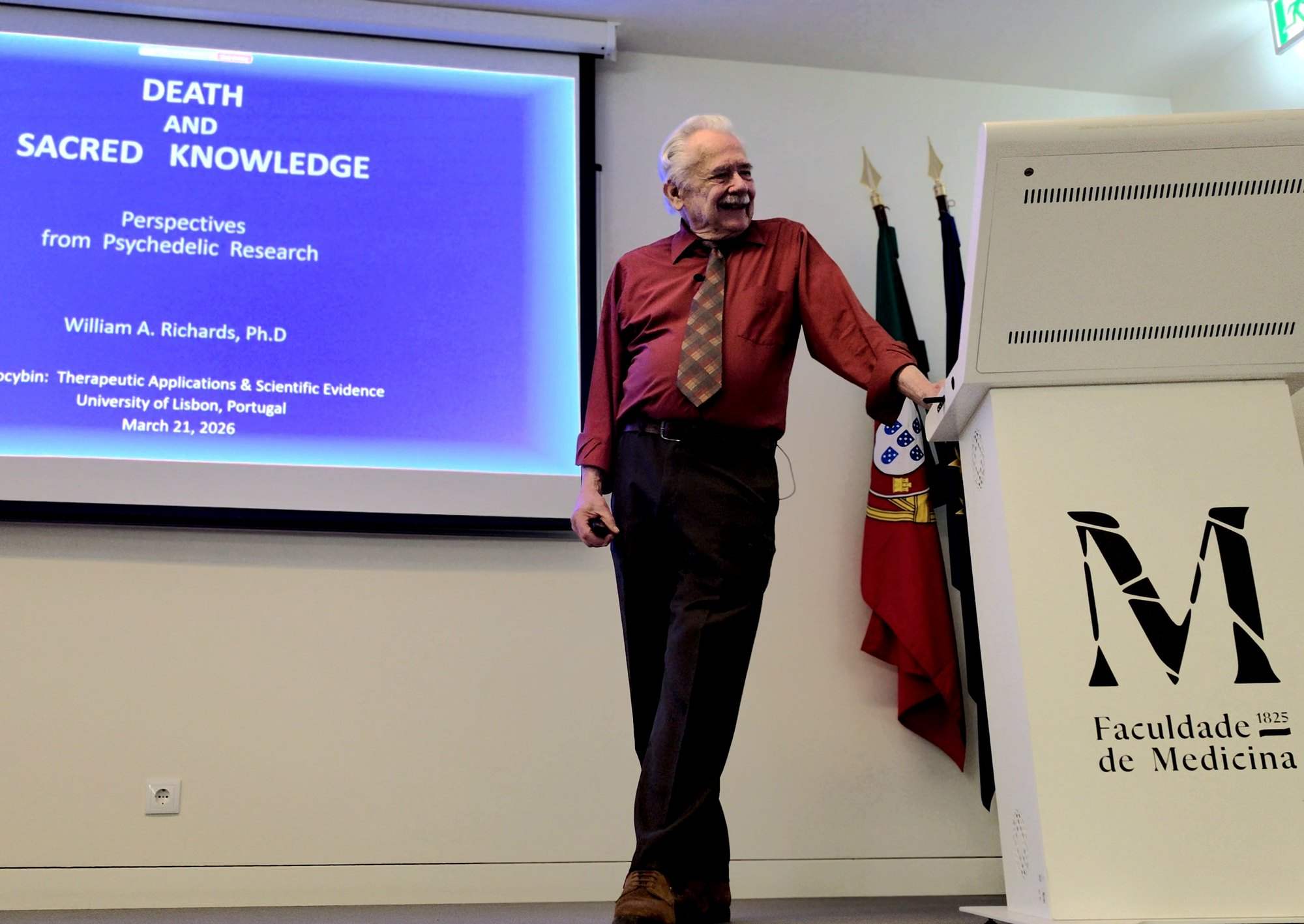
This was one of the subjects addressed at the Faculty of Medicine of the University of Lisbon within the course “Introduction to Psychedelic Therapy: Research and Clinical Practice”. William A. Richards’ participation brought the experience of a researcher associated with the history of psychedelic psychotherapy to this university setting. This article explores the subject through published sources; it is not a transcript of his contribution.
A career spanning psychology and the study of human experience
William Richards is a clinical psychologist at the Johns Hopkins Bayview Medical Center, whose work is associated with psychedelic research at Johns Hopkins, and he has training in theology and comparative religion. Earlier in his career he carried out psychedelic research in Baltimore, at Spring Grove Hospital Center and the Maryland Psychiatric Research Center. He is the author of the book Sacred Knowledge (2015). These details help place a career spanning several decades and different approaches to human experience. Biographical note — Columbia University Press.
That career deserves to be understood beyond the label of “pioneer”. Its editorial relevance lies in the connection between clinical observation, research questions and attention to how people describe their experiences. A subjectively important experience can provide a starting point for research; it does not replace methods for evaluating benefits, risks and differences between participants.
What the studies involving people with cancer investigated
In 2016, a Johns Hopkins trial involving 51 participants with life-threatening cancer found reductions in depression and anxiety after psilocybin. The randomised, double-blind, crossover study compared a high dose with a very low dose of psilocybin used as a placebo, and included a six-month follow-up. William Richards was a co-author. Griffiths and colleagues, 2016.
In the same year, a randomised, double-blind New York University trial involving 29 participants compared psilocybin and niacin (used as an active control), with psychotherapy in both conditions. It also found improvements in symptoms of anxiety and depression. Ross and colleagues, 2016.
Understanding the question these studies asked is important: they investigated psychological distress associated with cancer. They did not demonstrate that psilocybin treats a tumour, changes the cancer prognosis or prolongs life. Nor do they establish that everyone receiving palliative care would benefit. “Life-threatening illness” and “the last days of life” do not describe the same population. What is known about this substance is summarised on our psilocybin page.
Time matters — and so do the limitations of follow-up
A follow-up published in 2020 reassessed some participants from the NYU study and described continuing benefits. The small number reassessed and the absence of a new controlled comparison limit interpretation. Agin-Liebes and colleagues, 2020.
More recently, a study published in 2025 in the journal Cancer reported the two-year follow-up of a phase 2 trial in 30 people with cancer and major depression who received a single dose of psilocybin with psychological support. The trial was open-label and single-arm, with no control group, and 28 participants were reassessed at two years. Continuing research matters, but does not automatically turn small studies into a definitive answer. Agrawal and colleagues, 2025.
When reading this literature, useful questions include how many people participated, who was excluded, how distress was measured and what happened to people who did not improve. The duration of an improvement matters; so does whether it can be reproduced in other settings. In controlled trials, psilocybin’s intense subjective effects make blinding difficult: participants and staff may be able to tell which intervention was received, even when an active comparator such as niacin or a very low dose of psilocybin is used. This can influence expectations and ratings, and should be weighed when interpreting the results.
Meaning, spirituality and freedom of interpretation
Existential questions do not require a religious answer. For one person, meaning may involve reconciliation; for another, closeness to family, independence, continuity of a project or simply a day with less fear. A respectful clinical approach should leave room for these differences.
The word “spiritual” can describe questions of meaning and connection without presupposing a particular belief. It should not impose an interpretation on a person or present psychedelic experiences as objective revelations about death. In clinical care, the task is to understand the experience and its effects on life while respecting individual values, doubts and beliefs.
A question within care, rather than outside it
The World Health Organization describes palliative care as addressing physical, psychological, social and spiritual suffering. This framework reminds us that support for someone with serious illness should be comprehensive. WHO — palliative care.
Research into a new intervention should be in dialogue with that care. It should not diminish psychological support, symptom management or family support. For someone facing serious illness, excessive promises can be particularly harmful: they add pressure to “have a good experience” or find a solution that may not be appropriate.
Why this subject matters in the FMUL course
Bringing this discussion into university education allows scientific reading, clinical experience and ethical reflection to meet. The question is not simply whether an intervention produces an intense alteration of consciousness, but whether it can reduce suffering in a clinically meaningful way, for whom, under what conditions and with what support.
William Richards’ contribution places these questions within a long history. The commitment that should guide their development remains current: rigorous research and care that treats each person with dignity. This article is educational.