A news report about a clinical trial, a social media account and a drug-use survey answer different questions. They may mention the same substance, but do not describe the same reality. Understanding the presence of psychedelics in Europe requires knowing who is being observed, over what period and through which method.
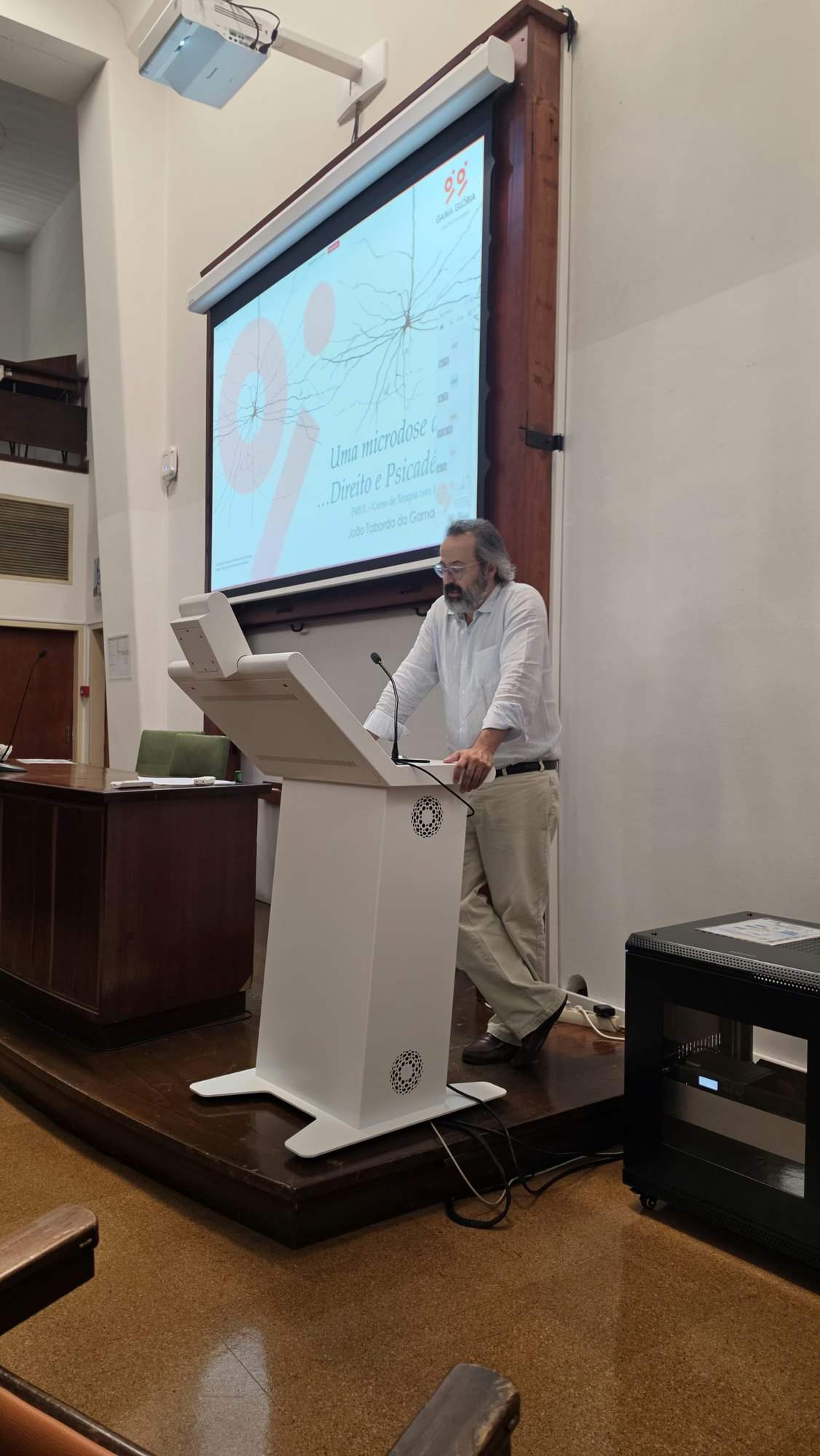
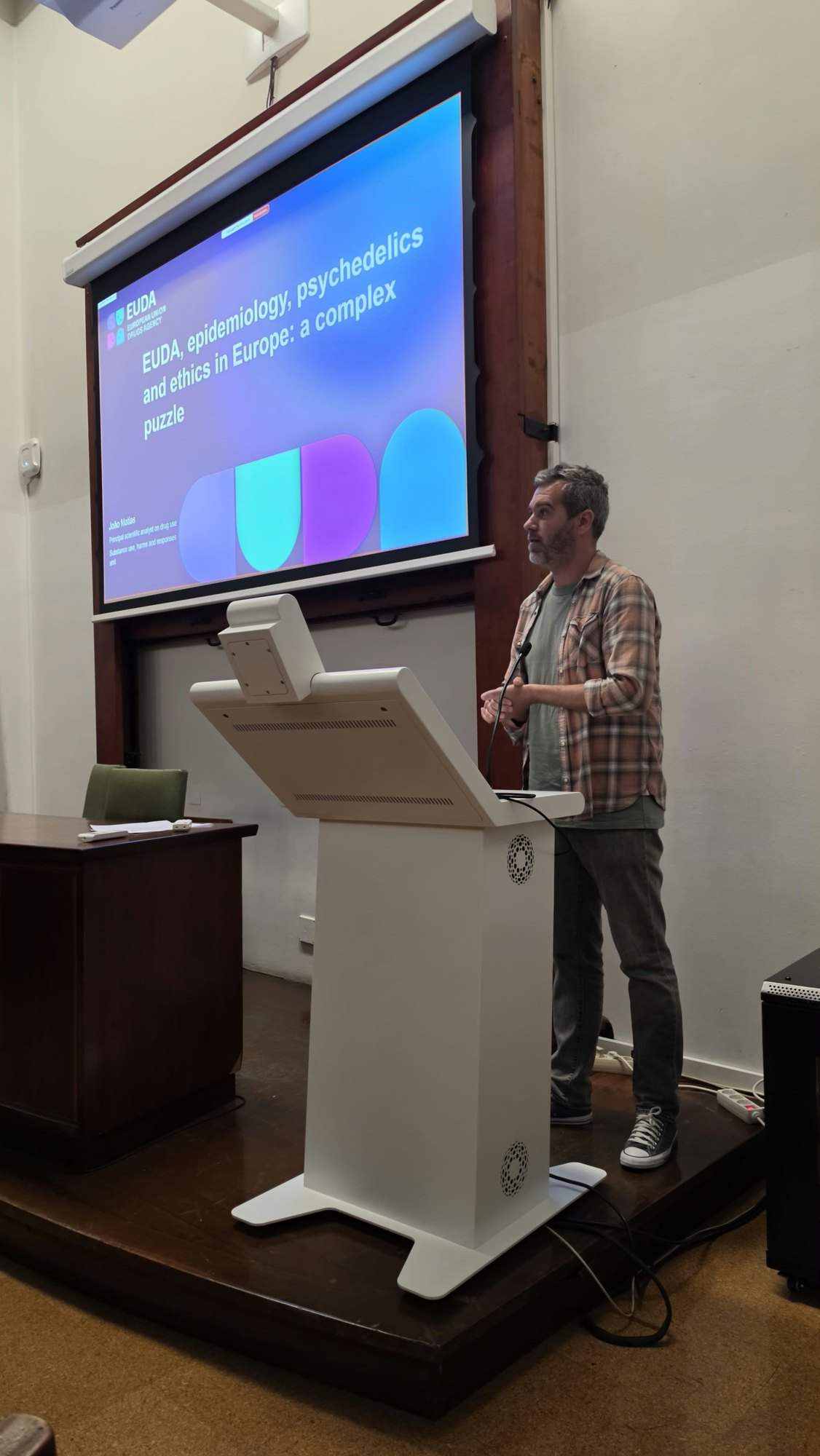
João Matias, from the European Union Drugs Agency, addressed these questions at the Faculty of Medicine of the University of Lisbon during the course “Introduction to Psychedelic Therapy: Research and Clinical Practice”. This article develops the subject using institutional sources, without attributing undocumented statements to the speaker.
João Matias and the epidemiology of drug use
João Matias is part of the scientific staff of the EUDA, the agency that succeeded the European Monitoring Centre for Drugs and Drug Addiction. At the Lisbon Addictions 2024 conference, the agency itself lists him as chair of the sessions on drug-use trends and on innovative methods for understanding drug markets and policy. EUDA — the agency at Lisbon Addictions 2024.
This perspective is particularly useful when public discussion moves faster than monitoring systems. Growing interest may exist before its scale can be measured. Changes within a particular group may also fail to represent the wider population. Epidemiology makes those differences explicit.
A European picture assembled from different years and populations
The European Drug Report 2026 presents national survey findings with different dates and age ranges. Examples of last-year use of hallucinogenic mushrooms include 2.7% in Czechia in 2024 and 2.5% in the Netherlands in the same year among young adults (aged 15 to 34). These national figures are not a European average. EUDA — other drugs, 2026 report.
Before comparing countries, it is important to check whether age groups match, questionnaires use the same definition and observation periods are similar. An apparent difference may reflect a real change, a methodological difference or both. The publication date of a report is not necessarily the collection date of each indicator.
“Ever used” measures something different from “used in the past twelve months”. Neither measure alone tells us about frequency, circumstances or support needs. Responsible reporting should keep the denominator alongside the number and explain what can be concluded from it.
An online survey does not represent the whole population
The European Web Survey on Drugs 2024 used a self-selected sample of people who use drugs. Findings for respondents in 24 EU countries and Norway included 18% reporting hallucinogenic mushrooms or truffles and 14% a dissociative anaesthetic in the past year. These are not estimates of use among all Europeans. EUDA — survey findings and survey methodology overview.
This illustrates how a correct figure can produce an incorrect message. Removing the sample definition turns an observation about survey participants into a claim about millions of people they did not represent. Methodological transparency belongs in the report itself, rather than being hidden in a technical note.
Use, experience and treatment are separate dimensions
The category “psychedelics” brings together different substances and settings. The EUDA distinguishes classical psychedelics from other substances commonly included in this debate, such as dissociatives and entactogens. What is known about the medical use of ketamine and esketamine, the dissociative anaesthetics most studied in psychiatry, is summarised on a page of its own. Its 2024 FAQ also describes difficulties monitoring unregulated practices presented as therapeutic or wellness services. EUDA — therapeutic-use FAQ.
For public analysis, participation in a trial, regulated treatment, recreational use and a retreat experience should be distinguished. Combining them in a single count loses information about supervision, goals and responsibilities. Seeking emotional relief does not make a practice equivalent to clinical care.
Popularity must also be separated from effectiveness. An increase in use does not demonstrate therapeutic benefit. An improvement observed in a clinical study does not establish that use outside that setting has the same outcomes. Public health needs to follow both dimensions without conflating them.
Which questions should accompany the next figures?
A useful reading starts with concrete questions: was the substance reliably identified? Does the measure concern people, episodes or services? Does collection include only volunteers? Is there information about negative consequences and care-seeking? Can the method capture groups that rarely appear in surveys?
These questions also help interpret gaps. Missing information is not equivalent to an absence of risk. Yet an isolated signal is not enough to establish an epidemic. Communication should resist both indiscriminate enthusiasm and alarmism.
Education to understand a changing reality
Discussing these subjects at FMUL reinforces the value of education that brings together clinical care, research and public health. Before deciding how to respond to a phenomenon, it must be described carefully. That requires methods, clear language and a willingness to acknowledge what is not yet known.
The epidemiological contribution associated with João Matias’ career reminds us that numbers are tools for understanding. To be useful, they must retain context. In a field with considerable public visibility, precision about the denominator, date and population is an essential form of rigour.